Wednesday, October 3, 2012

The Gap

There's a crippling problem with cosmological and teleological arguments.  Even if they succeed at showing there was some sort of force or forces that caused the universe, or that played a supernatural causal role in evolution, or the fine tuning of physics to be biophillic, they don't show that it was God.  That is, you can't get the God that people believe in--the all powerful, all knowing, all good creator of the universe, the God of Christianity, Allah, Jehovah, Jesus, and so on--from the argument.  The arguments underdetermine theistic belief.  I've been calling this The Gap.  And the widespread consensus in philosophy now is that this is one of the central reasons that natural theology as it has been pursued for centuries, fails.  Here's a slide I worked up recently to illustrate the problem more graphically.


Tuesday, October 2, 2012

Debate: Does God Exist?

Last week, Russell DiSilvestro and I debated the existence of God for an audience of a couple hundred at California State University, Sacramento.  Here's a link to a video of the discussion.

Does God Exist? McCormick and DiSilvestro

Russell presented a form of the moral argument: roughly, he argued that the objective value of honesty as a virtue implies that there must be a God.  Such moral facts cannot be explained as well by any other natural or supernatural hypothesis.

I presented an argument from divine hiddenness for atheism.  That is, if there were an almighty, all knowing creator of the universe who sought our belief on the basis of evidence, then the evidence would be much better than we find it.  The evidence we find is poor, and there are countless people with epistemically inculpable non-belief.  God, if there were one, could have made non-belief epistemically culpable.  Therefore, there is no God.

We also offered objections to each other's arguments and considered a number of good questions from the audience.  Hope you find the video interesting.

Wednesday, September 26, 2012

Impossible, or Void of Content


We're working on Patrick Grim's "Impossibility Arguments" in The Cambridge Companion to Atheism in my Atheism course.  Here's a particularly striking argument:

Because the [impossibility] arguments at issue operate in terms of a set of more or less clear specifications, of course, it is always possible for a defender of theism to deflect the argument by claiming that the God shown impossible is not his God. If he ends up defending a God that is perhaps knowledgeable but not omniscient he may escape some arguments, but at the cost of a peculiarly ignorant God. The same would hold for a God that is perhaps powerful but is conceded to be less than omnipotent, or historically impotent but not literally a creator. If the term "God" is treated as infinitely re-definable, of course, no set of impossibility arguments will force the theist to give up a claim that "God" in some sense exists. The impossibility arguments may nonetheless succeed in their main thrust in that the "God" so saved may look increasingly less worthy of the honorific title.

A more frequent reaction, perhaps, is not redefinjtion but refuge in vagueness: continued use of a term "God" that is allowed to wander without clear specification. Here as elsewhere - in cases of pseudoscience, for example - resort to vagueness succeeds in deflecting criticism only at the cost of diluting content. If a believer's notion of God entails anything like traditional attributes of omniscience, omnipotence, and moral perfection, the force of impossibility arguments is that there can be no such being. If a believer's notion of God remains so vague as to escape all impossibility arguments, it can be argued, it cannot be clear to even him what he believes - or whether what he takes for pious belief has any content at all.

The whole article, with several arguments for why omniscience and omnipotence are impossible, is here:

Patrick Grim, Impossibility Arguments

Grim surveys several of the most recent, most logically sophisticated accounts of omnipotence and omniscience from Flint and Freddoso, Rosenkrantz and Hoffman, and Wierenga.  None of the explanations work, he argues, because they either fail to be of sufficient scope to be worthy of God, or by being overly ambitious, they collapse under logical counter examples.  That is, God's properties, whatever they are, must be sufficiently maximal.  God, in order to be God, must have as much knowledge and power as can be had.  But on the best accounts we have, omnipotence and omniscience are anemic and mundane beings could qualify.  The most knowledge and power that any being can have are not enough to be God worthy.  The result, suggests Grim, is that after thousands of years of grappling with the problem, we still don't have a clear account of what it would be to be omnipotent or omniscient.  The implication is that we should conclude that the properties are impossible, unless the theist can produce some account that makes sense and that clarifies his claim that he believes in such a being.


Tuesday, September 25, 2012

Monkey Morality

I'm doing some research for my debate about God this week.  Prof. DiSilvestro is going to give a version of the moral argument for God.  I'll post my notes/essay shortly.  Here's a great video from primate researcher Frans de Waal about moral behaviors in chimps.

http://www.youtube.com/watch?v=GcJxRqTs5nk&feature=player_detailpage

Sunday, September 16, 2012

Book Tour Events This Fall


I’ll be giving invited lectures, doing debates, and talking about the book at a number of locations this fall.  Here’s a draft of the schedule.  Details subject to change. 

Sunday, Sept. 16
Interview about Atheism and the Case Against Christ
10:00 am
AM 950 Radio KTNF  The Progressive Voice of Minnesota
Atheism Talk with Carl Hancock and Brianne Bilyeu


Thursday, Sept. 27
Debate:  The Existence of God
with Russell Disilvestro
Redwood Room
Student Union
California State University, Sacramento
9:00-10:30 am

Tuesday, Oct. 9, 6:00-8:00 pm
UC Berkeley:
The Salem Witch Trials:  Why the Resurrection is Unreasonable
Berkeley Students for a Nonreligious Ethos (SANE)
Genetics Plants Biology (GPB) Building, Room 100
Berkeley, CA


Friday, October 12
The Salem Witch Trials:  Why the Resurrection is Unreasonable. 
UC Davis
AGASA
Haring Hall 2205
6:00-9:00 pm
Davis, CA


Nov. 7 or 8
Stanford University
Magic, Resurrections, Miracles, and Reasonable Belief
Details-  TBD
Palo Alto, CA 


Wednesday, Nov. 14
CSUS The Salem Witch Trials:  Why the Resurrection of Jesus is Unreasonable
3:00-5:00
CSUS Philosophy Club
Orchard Suite
Student Union
California State University, Sacramento

Thursday, Dec. 6
Disproof Atheism Society
Rm. 203, Photonics Center
Boston University
7:15 pm
Boston University Photonics Center
8 St. Mary’s St., Boston, MA

Sac FAN
The Salem Witch Trials:  Why the Resurrection is Unreasonable
TBD
Sacramento, CA

East Bay Atheists
Berkeley, CA
TBD

Sunday, Feb. 10th
SF Atheists
Women’s Building
Mission, SF
3:00?

Thursday, September 13, 2012

The Basics


Disagreeing about God is easy.  If we are going to make headway in our conversations about God, however, we’d do well to focus first on our common ground.  At the risk of getting abstract and boring:  Suppose Smith and Jones disagree about matter p.  And suppose that S and J are both reasonable, thoughtful people with the intention of getting their beliefs to align as well as they can with the facts and the canons of inductive and deductive reasoning.  Smith will have one body of information that Smith takes to be relevant to deciding the issue and Jones will most likely have another.  There will no doubt be some overlap between, but the disagree is often related to different pieces of information in those two bodies of evidence.  Smith and Jones need to share evidence, and come to some agreement about what the complete list of facts are regarding p, or at least the most complete list that they can acquire. 

The disciplines of physics, astronomy, cosmology, anthropology, biology, psychology have converged on this short summary of the history of everything.  A staggering and  unsurpassed amount of work, critical reasoning, skeptical scrutiny, vetting, and aggressive efforts at disconfirmation that have gone into justifying this account of the history of everything.  That is, the story is the result of the greatest minds in human history using our best methods for investigating the world. 

The arguments that one might make for some other version of events, or the evidence that one might cite to justify a contrary picture of reality, are all inferior.  To prefer one of those alternative accounts of reality is, plainly stated, flagrantly irrational. 

So discussions about God need to start with this bit of evidence sharing as their starting point. 

Here’s a summary of what we know about the universe, the Earth, life, humanity, and evolution. 


Approximately 13.7 billion years ago, the universe went from a singularity state of infinite curvature and energy to a rapidly expanding chaotic state, the Big Bang.  During the first pico and nano seconds of this period of rapid expansion, the types and behavior of particles that existed rapidly change as the energy levels dropped.  Within a few nanoseconds, the kinds of matter and the ways they behave settled into, more or less, the sorts of material constituents we find today.  At this point, only hydrogen, helium, and lithium exist.  The matter continues to expand outward and eventually, several billion years later, gravitational pull congregates clumps of matter together to form stars.  These heat and energy at the cores of these stars cook the early forms of matter, transforming it and creating many of the other, heavier elements on the periodic table.  Some of these stars are of sufficient mass to ultimately collapse on themselves, exploding outward and spraying the new elements formed in their cores out into space.  That matter eventually coalesces into smaller stars, planets and moons like our own.

The Earth formed about 4.5 billion years ago.  Simple, self-replicating molecules appear on Earth around 4 billion years ago (abiogenesis).  Once there is replication, natural selection and random mutations over billions of years lead to the evolution of more and more life forms, many of them of increasing levels of complexity.  The dinosaurs emerge from this  process.  The Triassic, Jurassic, and Cretaceous periods range from about 208 million years ago to 65 million years ago.  There are boom and bust cycles of rapid proliferations of life (e.g. Cambrian explosion) and mass extinctions, such as the asteroid event that we think was responsible for the extinction of the dinosaurs.  The ecological gap left by the dinosaurs provides the opportunity for placental mammals to expand and diversify. 


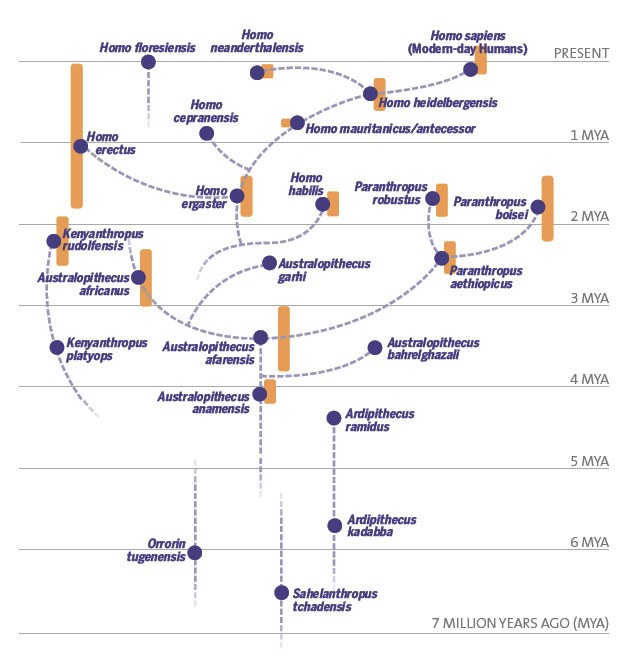
The earliest known stone tools originate with hominids 2.5 to 2.6 million years ago.  Estimates about the emergence of language range from 5 million years ago to 100,000 years ago.  Modern humans (homo sapiens) originated in Africa about 200,000 years ago, 60 million years after the dinosaurs have gone extinct.  A variety of early hominid groups vie for survival until all related lines except homo sapiens are extinct.  We are still piecing together many of the connections and relationships between these species.


There is evidence of human religious behavior such as burial rituals dating back approximately 300,000 years. 
Only very recently have one of the hominid species--homo sapiens--on the planet developed cognitive faculties that were sophisticated enough to be able to discover these various facts about the universe.  Some of those discoveries are landmarks of vast significance in our develop, although not in a cosmic scale:  Darwin’s The Origin of Species is published in 1859. In 1929, Edwin Hubble published his paper, “A Relation Between Distance and Radial Velocity Among Extra-Galactic Nebulae,” in which he showed that the universe is expanding.  Extrapolating backward from its rate of expansion made it possible to date the explosive beginning of the universe at approximately 13.7 billion years ago.  In 1953, James D. Watson and Francis Crick published their discovery of DNA in Nature:  “A Structure of Deoxyrobose Nucleic Acid.” 

Sharing Evidence

Now it seems to me that any religious doctrine that portends to give an accurate account of the nature of the universe, the origins of the universe, the existence and development of life, the origins of humanity, or the relationship between humanity and the rest of the cosmos must, at the very least, accord with this history of everything.  If a religious account of the world presents us with different details about the order, span, or nature of these events, then we must conclude that is it mistaken.  4 in 10 Americans are young Earth creationists http://www.gallup.com/poll/145286/four-americans-believe-strict-creationism.aspx  where young Earth creationism is the view the universe, the Earth, and all life on Earth were created in their more or less present forms within the last 10,000 years.  So that 40% of the population believe a number of things that are flatly disproven by our best evidence and scientific work.  (The oft repeated claim that religious views and science are perfectly consistent or compatible is also plainly false in this light.) 

Responsible and mature discussions about God should start with this mutually agreed upon list of basics about the universe we inhabit.  Denying these basics, given the quantity and quality of evidence we have in their favor, is irrational and irresponsible.  Someone who would deny the basics is either grossly misinformed, or perhaps he is more committed to the religious ideology than to believing that which is reasonable and best supported by the evidence. 

  • The Big Bang occurred 13.7 billion years ago.
  • Only hydrogen, helium, and lithium exist for millions of years until large stars form and create many of the other, heavier elements on the periodic table. 
  •  Some of these stars go supernova and distribute these new elements into space. 
  • That matter eventually coalesces into smaller stars, planets and moons like our own. 
  • The Earth formed about 4.5 billion years ago. 
  • Life in the form of the simplest, self-replicating molecules occurs on Earth around 4 billion years ago.
  • Once there is replication, natural selection and random mutations over billions of years lead to the evolution of more and more life forms, many of them of increasing levels of complexity. 
  • Dinosaurs live from about 208 million years ago to 65 million years ago. 
  • Life on the planet goes through several mass extinctions.
  • The Cambrian explosion—a rapid proliferation of the kinds and numbers of living organisms on the planet,  occurs about 540 million years ago.
  • Mammals begin to expand and diversify significantly about 54 million years ago.
  • Modern humans (homo sapiens) originated in Africa about 200,000 years ago. 
  • Human religious behavior starts approximately 300,000 years ago. 

Tuesday, September 11, 2012

Atheism and the Case Against Christ, now available.


It's real.  


It's available at Amazon here.

In the coming weeks I'll be giving talks at UC Berkeley, Stanford, CSUS, UC Davis, and for Sacramento and Bay area atheist groups.  I'll post details here as they are firmed up.


Monday, August 27, 2012

It's Out!

Prometheus tells me that they've received my book from the printer and it's going out now.  They have it here:  Atheism and the Case Against Christ  


Amazon is showing it as out of stock, but that should change this week?  

MM


Wednesday, August 15, 2012

Atheism and the Case Against Christ comes out late Aug. to mid Sept.

The publisher says it will be out in 3-4 weeks!

Wednesday, July 25, 2012

Publication date pushed back

Hi all.  First, thanks so much for all my readers who have ordered the book and who are anxious to read it, including the eager apologists.  Publishing a book is a long and complicated process.  I've been working on final revisions, editing, corrections, and proofreading for months.  The index is done finally and sent off to Prometheus.  From what they tell me, it's going to be several more weeks to get the final version printed up and shipped out.  So please hang on--it's coming.

Matt McCormick


Thursday, June 7, 2012

Disagreeing about Religious Disagreements

Rich Feldman, as usual, sheds a great deal of clarity on religious disagreements here:

Reasonable Religious Disagreements

He endorses this view after considering several alternatives:

After examining this evidence, I find in myself an inclination, perhaps a strong inclination, to think that this evidence supports P. It may even be that I can’t help but believe P. But I see that another person, every bit as sensible and serious as I, has an opposing reaction. Perhaps this person has some bit of evidence that cannot be shared or perhaps he takes the evidence differently than I do. It’s difficult to know everything about his mental life and thus difficult to tell exactly why he believes as he does. One of us must be making some kind of mistake or failing to see some truth. But I have no basis for thinking that the one making the mistake is him rather than me. And the same is true of him. And in that case, the right thing for both of us to do is to suspend judgment on P.

That is, he rejects the widely held notion that it is possible for epistemic peers to share their evidence and reasonably maintain their own beliefs and think that the other party remains reasonable.  You've got to give up your view and retreat to suspension of judgment in the face of an epistemic peer who considers the evidence and still disagrees with you, and she should do likewise.  Notice also that Feldman gives some considerable creedence to the notion that someone could have a piece of unsharable evidence.

On Feldman's scheme, when the positive atheist is confronted by a theist, call her Smith, the atheist might conclude that Smith is not an epistemic peer because she is not "equal with respect to intelligence, reasoning powers, background information, etc."  Starting with the last one first, the atheist might hope to convince Smith by getting her up to speed on the relevant background information.  Or Smith might hope to improve Smith's reasoning powers or skills.  The atheist may not be able to do much about Smith's lack of intelligence, of course.

The obvious point is that the atheist must acknowledge the disagreement may be the result of the fact that that he, the atheist, is lacking with respect to intelligence, reasoning, powers, background information, etc.  The atheist, just like everyone else, must take great care in the face of disagreement to not simply assume that the fault lies on the other side.  It's hard to know whether atheists or theists are more prone to this assumption of epistemic superiority mistake.  In general, the evidence that shows that belief in God is negatively correlated with education, intelligence, and analytical skill does seem to tilt the situation in the atheist's favor. But that general evidence doesn't show that any particular atheist or his position is not the result of some epistemic mistake or problem.  Individuals and the reasonableness of their views must be treated individually.

It seems to me that there's something wrong with Feldman's Modest Skeptical Alternative account in the end.  He's rushing to suspend judgment too readily.  Perhaps that's because he's lacking some background information with regard to religious disagreements.  Having been a student in several of his graduate seminars in epistemology, I certainly won't argue that he's not equal with respect to intelligence or reasoning powers.

I have a couple of half baked ideas here:  I am worried that the powerful human propensity to construct complicated and sophisticated rationalizations for some view out of motivated reasoning can give the illusion that someone is an epistemic peer, or that her view warrants more epistemic respect than it deserves.  (This worry should plague you about your own views as much as about someone who disagrees with you.)

More specifically, the religious urge is powerful and neurobiological, much more so than some commensurate skeptical or atheist urge.  And the propensity towards sophisticated motivated reasoning feeds into the religious urge.  So we have a population of cognitive agents where religious mistakes defended with elaborate rationalizations are the widespread norm.  Given human psychological constitution, we should expect to find a lot of impressive reasoning in favor of belief.  In Feldman's terms, I think what that piece of information should do is show that the bar for taking a believer to be an epistemic peer is higher.  (Yes, I know how prejudicial that sounds.)  The case is comparable for astrology.  If Smith finds out that Jones believes in astrology, even if Jones gives what sounds like a sophisticated, and thoughtful justification for it, Smith ought to be reluctant to conclude that Jones is an epistemic peer.  Jones' belief should act as a defeater to the presumption of Jones' being equal with regard to intelligence, reasoning powers, or background information.  It's not that Jones cannot vindicate herself or her belief; it's just that the belief, in the context of the rest of what we know about the world and ourselves as cognitive agents, is very strong evidence that something's gone wrong on one or more of those three qualifications for being an epistemic peer.

Feldman, citing van Inwagen, says that belief in astrology is simply indefensible.  I agree.  Nevertheless, enthusiastic belief in it is widespread, and elaborate justifications are common.  In the case of astrology, my assumption is that if an adult endorses it, then he or she is most certainly lacking in background information, reasoning or analytical ability, or intelligence.  The only difference I can see with religious belief is that a bigger percentage of the population endorses it.

And now I see more clearly why atheists have the reputation for being smug and superior assholes.  Feldman, to his credit, is urging us to not go down that road.  But I don't see how it can be avoided.

Another way to put the point is to consider the larger populations of cognitive agents we are dealing with.  For virtually any idea, it is possible to find someone who believes it, who appears to be reasonable and thoughtful, and who is in possession of the relevant background information.  John Mack, infamous Harvard psychiatrist, vigorously defended the claim for many years that aliens were visiting the Earth, abducting humans, and conducting bizarre medical experiments on them.  Strange ideas are too seductive to human psychology, and there are too many of us.  There are thoughtful, intelligent, seemingly reasonable people who deny evolution, who believe in witchcraft, who believe that alien spacecraft are responsible for crop circles, who believe that Bigfoot is real, and so on.  If we apply Feldman's principle, then it would appear that we should suspend judgment about all of these matters.  And that result suggests that his principle encourages suspension of judgment about matters that are clearly reasonable to believe given the evidence.

Tuesday, May 8, 2012

Atheism and the Case Against Christ

Amazon has my book posted.  Publication date is July 24.  Exciting:


Monday, April 30, 2012

Thinking Analytically Leads to Religious Disbelief

In a recent issue of Science:  Analytic Thinking Promotes Religious Disbelief, by Will M. Gervais and Ara Norenzayan:

Scientific interest in the cognitive underpinnings of religious belief has grown in recent years. However, to date, little experimental research has focused on the cognitive processes that may promote religious disbelief. The present studies apply a dual-process model of cognitive processing to this problem, testing the hypothesis that analytic processing promotes religious disbelief. Individual differences in the tendency to analytically override initially flawed intuitions in reasoning were associated with increased religious disbelief. Four additional experiments provided evidence of causation, as subtle manipulations known to trigger analytic processing also encouraged religious disbelief. Combined, these studies indicate that analytic processing is one factor (presumably among several) that promotes religious disbelief. Although these findings do not speak directly to conversations about the inherent rationality, value, or truth of religious beliefs, they illuminate one cognitive factor that may influence such discussions.


Monday, March 19, 2012

Tripping Balls

A quick post while I'm on the road climbing. This study of over 13,000 subjects shows amazingly high rates for hallucinations in the general public. The implications for the advent and persistence of religion is obvious:

Prevalence of hallucinations and their pathological associations in the general population

Psychiatry Research
Volume 97, Issue 2 , Pages 153-164, 27 December 2000

Hallucinations are perceptual phenomena involved in many fields of pathology. Although clinically widely explored, studies in the general population of these phenomena are scant. This issue was investigated using representative samples of the non-institutionalized general population of the United Kingdom, Germany and Italy aged 15 years or over (N=13057). These surveys were conducted by telephone and explored mental disorders and hallucinations (visual, auditory, olfactory, haptic and gustatory hallucinations, out-of-body experiences, hypnagogic and hypnopompic hallucinations). Overall, 38.7% of the sample reported hallucinatory experiences (19.6% less than once in a month; 6.4% monthly; 2.7% once a week; and 2.4% more than once a week). These hallucinations occurred, (1) At sleep onset (hypnagogic hallucinations 24.8%) and/or upon awakening (hypnopompic hallucinations 6.6%), without relationship to a specific pathology in more than half of the cases; frightening hallucinations were more often the expression of sleep or mental disorders such as narcolepsy, OSAS or anxiety disorders. (2) During the daytime and reported by 27% of the sample: visual (prevalence of 3.2%) and auditory (0.6%) hallucinations were strongly related to a psychotic pathology (respective OR of 6.6 and 5.1 with a conservative estimate of the lifetime prevalence of psychotic disorders in this sample of 0.5%); and to anxiety (respective OR of 5.0 and 9.1). Haptic hallucinations were reported by 3.1% with current use of drugs as the highest risk factor (OR=9.8). In conclusion, the prevalence of hallucinations in the general population is not negligible. Daytime visual and auditory hallucinations are associated with a greater risk of psychiatric disorders. The other daytime sensory hallucinations are more related to an organic or a toxic disorder.

Wednesday, March 14, 2012

The F Word

I just gave a lecture to Cosumnes River College last night about faith based religious claims.  The slides I used are here

Sunday, March 11, 2012

Friday, March 2, 2012

Bias In Religious Thinking, II


I gave a public lecture at UC Davis last night about recent research on bias and its applications to religious thinking.  Here's my latest version of the slides.

The student group at UC Davis has posted a video of my talk here:  Bias and Heuristics in Religious Thinking
I didn't know about the camera's location, so I paced in and out of frame a lot during the talk. But maybe my explanations of the slide points are useful.

Wednesday, February 22, 2012

Favorite Atheist Blog?

My blog has been nominated for best atheism blog of the year by About.com.  Go here to vote if the mood strikes you:  http://atheism.about.com/b/2012/02/22/favorite-agnostic-atheist-blog-of-2011.htm


Tuesday, February 14, 2012

What is an Atheist?

The Drew School in San Francisco has invited me to speak as part of a lecture series from religious leaders.  I'll be speaking about atheism and tolerance on Wednesday, Feb. 15.  My lecture slides are here:

What is Atheism?

Bias in Religious Thinking


I recently gave a talk to a San Francisco atheist group about what I take to be some of the most common and serious biases and errors in religious reasoning and believing.  I’m applying a number of studies from Tversky, Kahneman, Dennett, McKay, Nisbett, decamp Wilson, and others.  I’m also identifying some of what I take to be some of the important ways in which believers and skeptics are talking across one another.  I’ll write up a few of the discussions soon.  For now, here’s a link to the slides I used.